15 Free Crochet Sweater Patterns You Can Make for Fall
There’s a specific week in early fall when the air turns and you suddenly want to be wrapped in wool. That’s usually when I start a new crochet sweater. Not a scarf, not another dishcloth. A real sweater, the kind you wear until the elbows go thin.
The good news: sweaters are far less scary than they look. Most of the pieces below are built from rectangles, simple raglan increases, or squares you stitch together at the end. If you can do a double crochet and count to ten, you can finish one of these before Halloween.
Below are 15 finished looks pulled straight from my inspiration folder, each one broken down so you can see the stitch, the shape, the yarn weight, and who it flatters. Use them as a shopping list for your next project. I’ve noted what makes each one work and where beginners tend to get stuck.
Affiliate disclosure: this post contains affiliate links. If you buy through them I may earn a small commission at no extra cost to you. I only link to supplies I’d actually keep in my own project bag.
1. Cream Cable Turtleneck Folded on a Bench: The Heirloom Starter Sweater
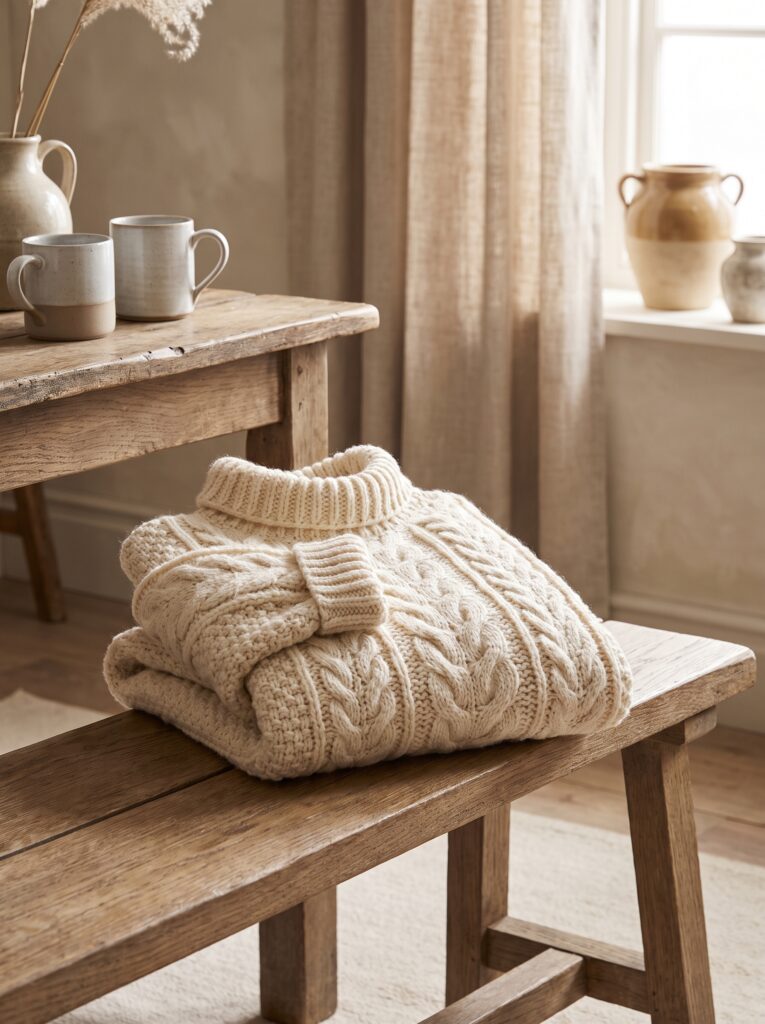
This is the sweater everyone pictures when they say “cozy.” Thick cream yarn, a rolled turtleneck collar worked in deep ribbing, and a body covered in twisting cables and moss-stitch panels. Folded on the bench, you can see how much fabric there is. That’s the point. A sweater like this should feel heavy in your hands.
The cables here are the faux-cable kind crocheters get with front post double crochet, which looks nearly identical to knitting once blocked. Between the cable columns sit narrow bands of textured stitches, so the whole surface stays interesting even in a single color. Cream shows off texture better than any other shade, which is why so many designers default to it.
If you want the same weight and drape, a wool blend in bulky weight is the safest bet.
Shop it on Amazon: Lion Brand Wool-Ease Thick & Quick.
Post stitches also chew through your hands, so an ergonomic hook helps.
Shop it on Amazon: Clover Amour Crochet Hook Set.
Worth noting: the collar is worked separately and attached, which means you can make it taller or shorter without touching the body.
2. Dusty Rose Mesh Pullover With a Scalloped Neckline
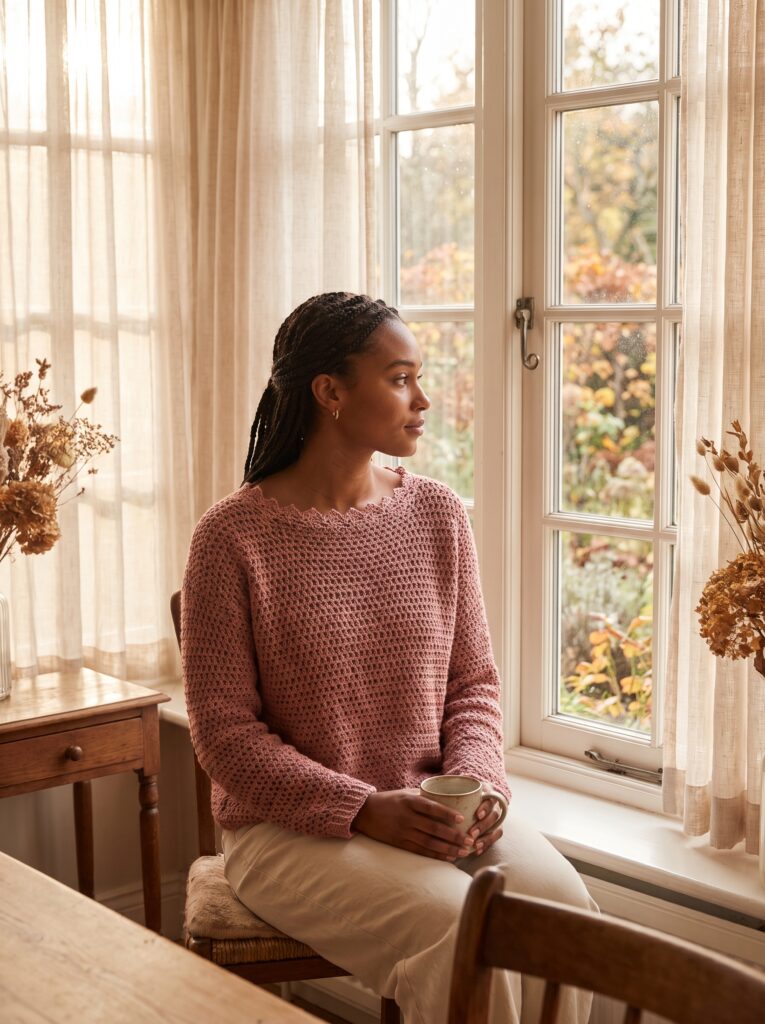
Pink sweaters get dismissed as spring pieces. This one proves otherwise. The shade is muted, closer to dried rose than bubblegum, and it sits beautifully against a fall window.
The stitch is an open mesh worked in rows, light enough to see through slightly but dense enough to hold shape. Look at the shoulders and you’ll spot raglan seam lines running diagonally, which tells you this crochet sweater was worked top down in one piece. The neckline finishes with a small scalloped edge instead of ribbing, a detail that softens the whole thing. Sleeves are long and slightly blouson, gathered into a snug cuff.
For a fabric this airy, skip the wool and reach for cotton blends. They hold the mesh open instead of letting it collapse. A fine gauge like this also needs blocking to look right, so lay it flat and pin it.
3. Oversized Ivory Openwork Sweater, Flat Lay With Pumpkins
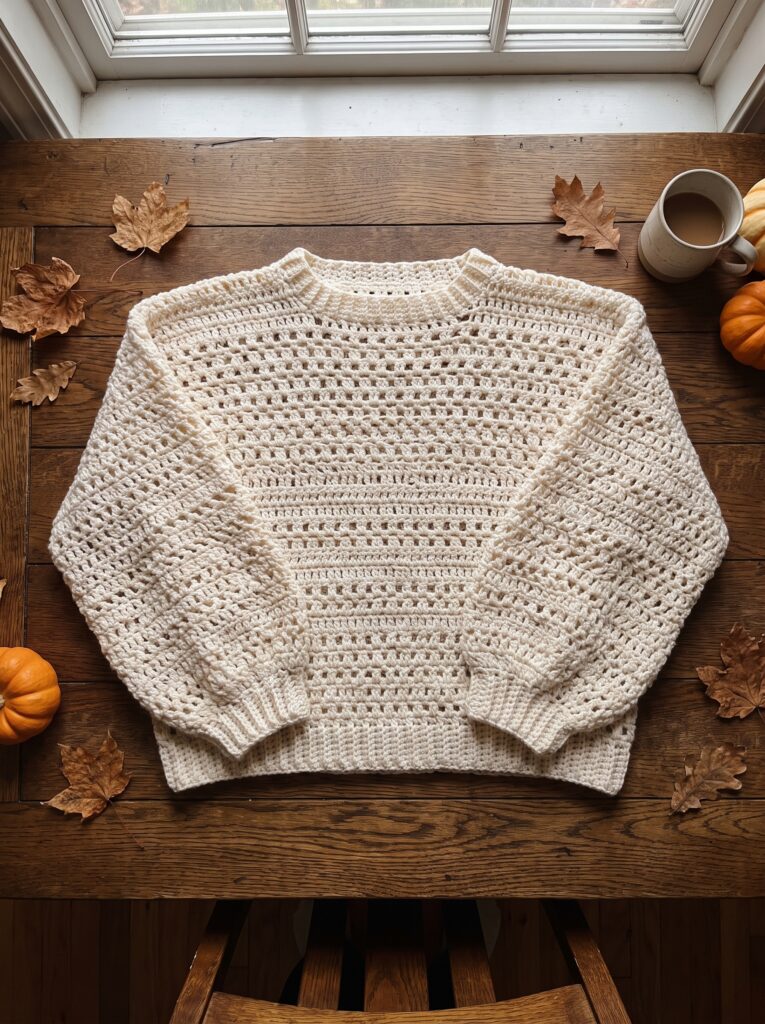
Flat lays tell you more about construction than any modeled shot. Here you can trace the seams: dropped shoulders, wide straight body, tapered sleeves ending in ribbed cuffs. No shaping at the waist at all.
The pattern alternates rows of solid double crochet with rows of eyelet spaces, giving it a horizontal stripe effect without a single color change. That’s a smart trick if you hate weaving in ends. The neckline is a plain round crew finished with two rows of slip stitch, and the hem gets a deep band of ribbing that pulls the boxy shape in just enough.
This is the easiest sweater on the list for a first-timer. Two rectangles, two sleeves, done. If you’re building your first real stash for a project this size, a chunky acrylic in a natural shade goes a long way.
Shop it on Amazon: Bernat Blanket Yarn.
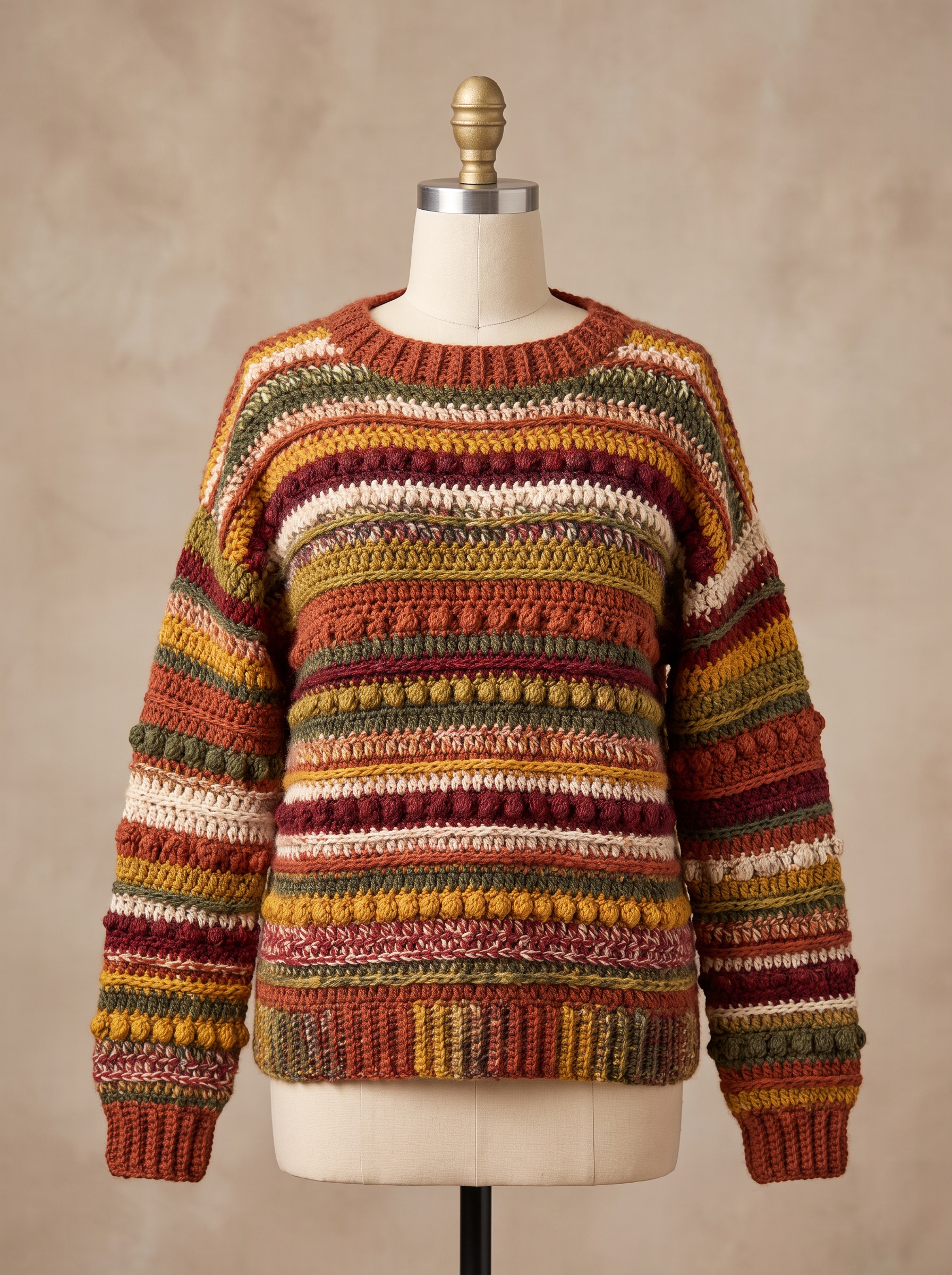
4. Scrap Yarn Stripes in Rust, Mustard, and Olive
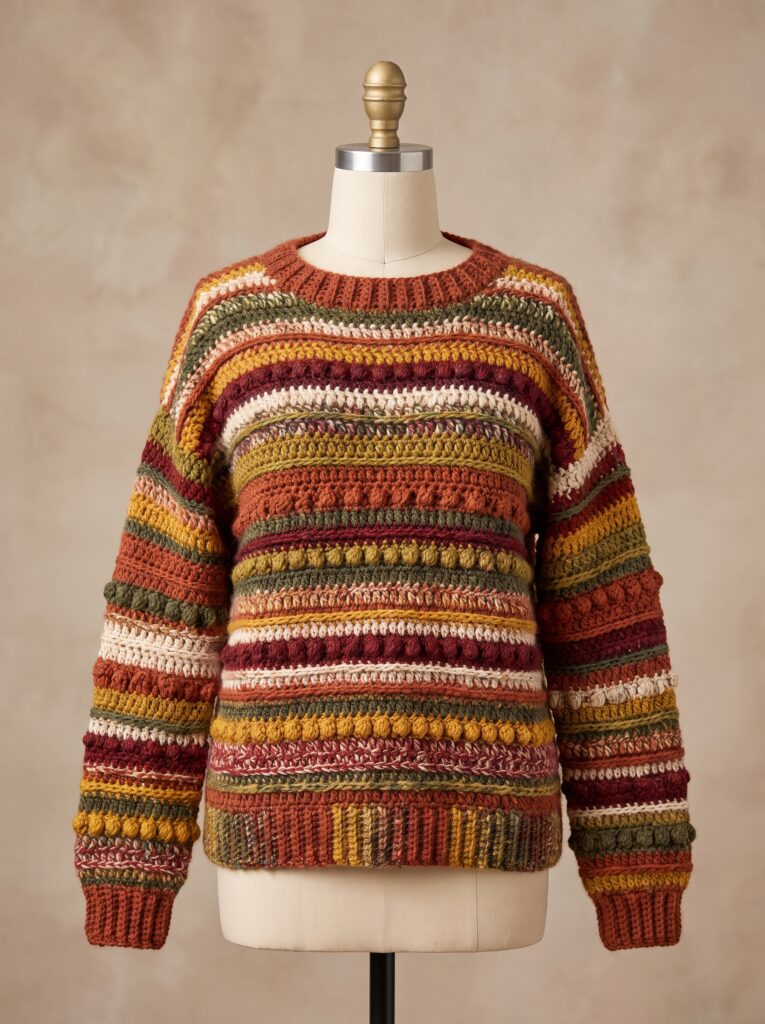
I love this one and I love it specifically because it’s chaos. Every stripe is a different stitch and a different color. Rust, deep burgundy, mustard, olive, cream, and a few marled blends nobody planned. That’s a stash-buster sweater in its truest form.
Look closely at the rows and you’ll count at least six textures: bobbles, puff stitch clusters, plain double crochet, single crochet ridges, and a braided cable band near the hem. The neckline and cuffs are all worked in the same rust, which is the trick that keeps the whole thing from looking like a mistake. Pick one anchor color, repeat it at every edge, and the rest can be as random as you want.
If you have half-balls piling up from other projects, this is where they go. Leftovers also work well for smaller makes, and I’ve rounded up plenty of those in this guide to 14 free crochet accessories ideas that can be gifted if you want to use the truly tiny scraps. For a project with this many color changes, sharp tapestry needles save your sanity.
Shop it on Amazon: Clover Chibi Darning Needle Set.
5. Caramel Long Cardigan for Walks in the Woods
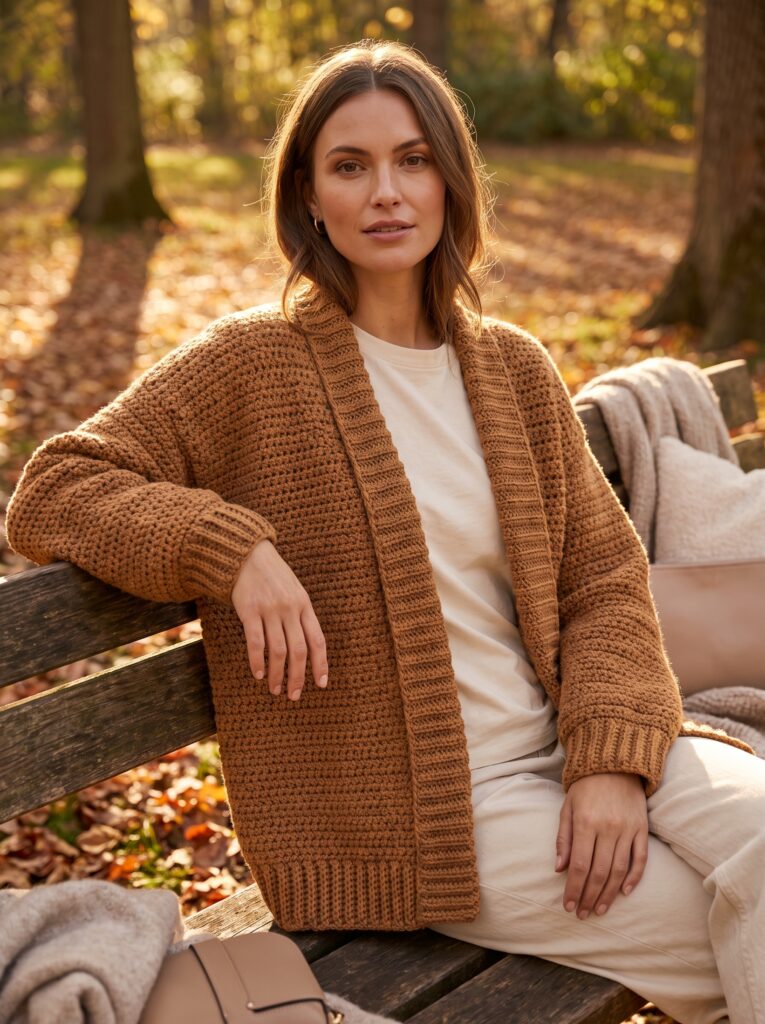
Cardigans are the sweaters you actually wear. Pullovers stay in the drawer on warm days. This caramel one hits mid-thigh, has no buttons, and drapes open over a plain white tee, which is exactly why it works from September through November.
The body uses a dense textured stitch, probably alternating single and double crochet, which gives it that slightly pebbled surface. The front bands are ribbed and wide, running from hem to hem in one continuous piece so there’s no seam at the back of the neck. Sleeves are roomy through the arm and gather into deep ribbed cuffs. The whole silhouette is loose without being shapeless.
Caramel is one of the most useful colors you can pick for fall. It reads warm against every skin tone and pairs with cream, black, navy, and denim. A wool blend in this weight keeps its shape over a long body, which matters when the cardigan is this long.
6. Forest Green Chunky Turtleneck With Rolled Sleeves
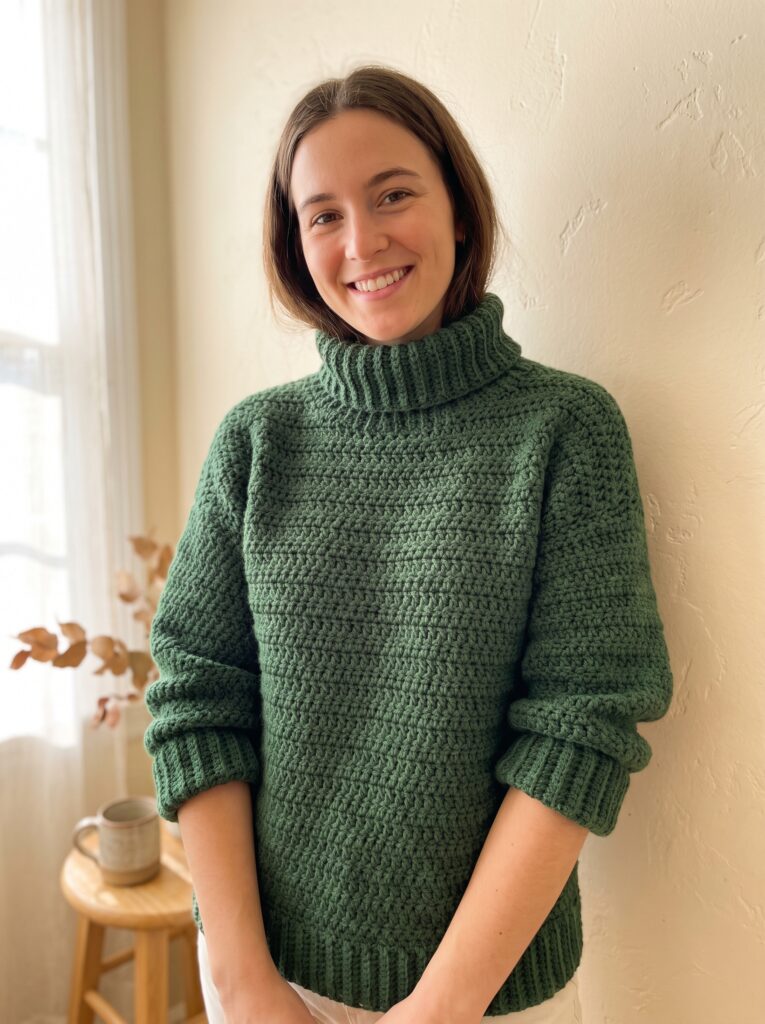
Green is having a long moment and I’m not mad about it. This deep forest shade is warmer than it looks in photos, especially in wool.
The stitch is a simple herringbone half double crochet worked in rows, which creates those slanted little V shapes across the surface. It’s fast, it’s forgiving, and it produces a fabric with more drape than plain double crochet. The turtleneck is a tall ribbed tube folded once. Sleeves are set in with a raglan line you can just make out running from the collar to the underarm, and the cuffs are pushed up here to show the ribbing.
The hem band is deep, maybe three inches, which stops a heavy crochet sweater from stretching out at the bottom. If your finished sweaters always grow, that’s usually the fix. Keeping track of raglan increase rows matters here, and a simple counter beats mental math.
Shop it on Amazon: Clover Kacha-Kacha Row Counter.
7. Close-Up: The Ribbed Cuff That Makes a Sweater Look Bought
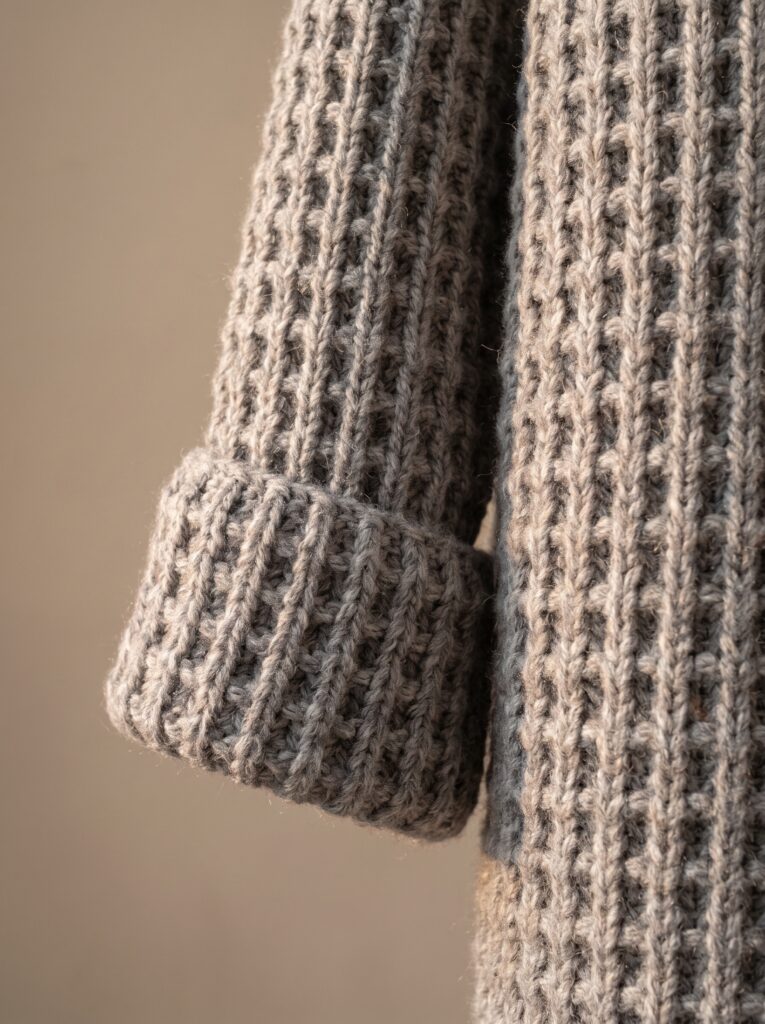
I wanted to include this detail shot because cuffs are where handmade sweaters usually give themselves away.
What you’re seeing is a taupe gray fabric in a fisherman-style rib, worked with front post stitches so it has real vertical columns and real stretch. The cuff is folded back on itself, doubling the thickness. That fold does two jobs: it adds warmth at the wrist and it hides any wobbly ends from where you changed yarn.
The body fabric next to it uses a slightly different rib, tighter and flatter, so there’s contrast between the sleeve and the cuff even though the color is identical. Small choice, big result. If you take one thing from this section, make your cuffs at least two inches deep and work them on a hook one size smaller than the body. That’s the whole secret. Blocking pins help hold the ribbing while it dries so the columns stay straight.
Shop it on Amazon: T-Pins for Blocking Knitting.
8. Rust and Cream Diagonal Colorblock Pullover
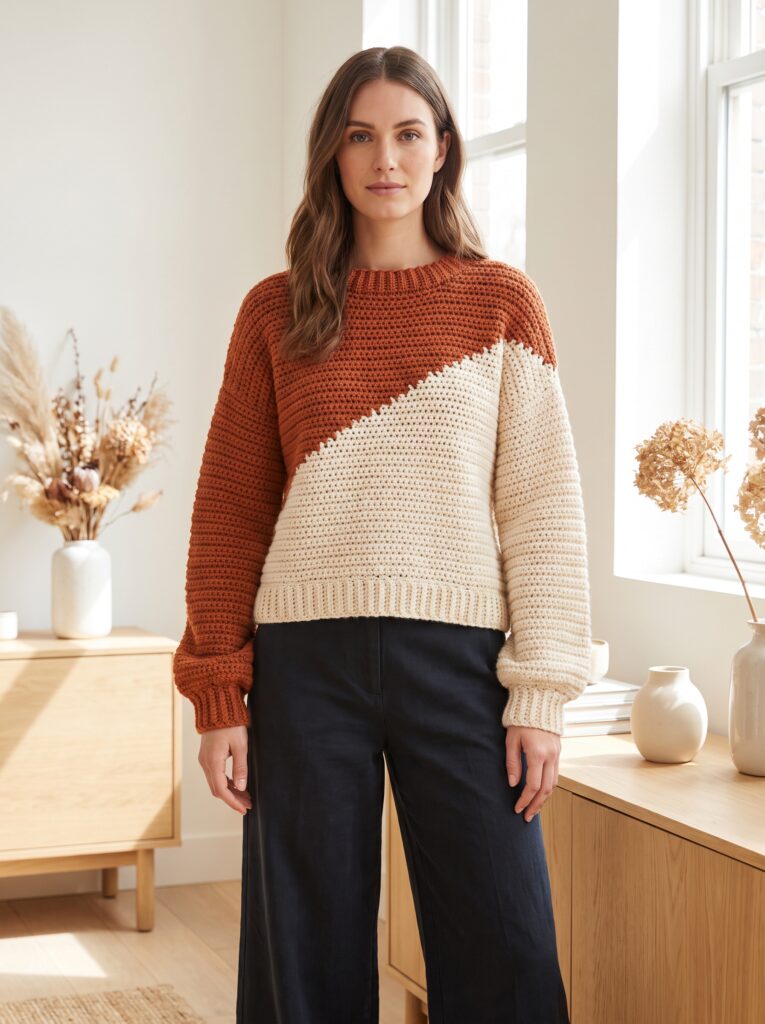
Colorblocking usually means a straight horizontal line. This one runs on a diagonal instead, splitting the sweater corner to corner so the rust covers one shoulder and sleeve while cream takes the opposite hip and arm. It’s a graphic look that photographs incredibly well, which is probably why it keeps showing up on Pinterest.
The stitch underneath is a textured suzette or alternating single and double crochet, dense and even. Both halves use the exact same stitch, so the only thing changing is color. The diagonal line has a slight zigzag edge where the color changes step across rows, and honestly that jagged edge is part of the charm.
Ribbing at the neck, hem, and cuffs matches whichever color that section falls into. Rust neckband, cream hem, one rust cuff, one cream cuff. Keeping your two yarn balls from tangling during the color change section is the main practical challenge.
9. Cream Openwork Sweater Vest Over a Crisp White Shirt
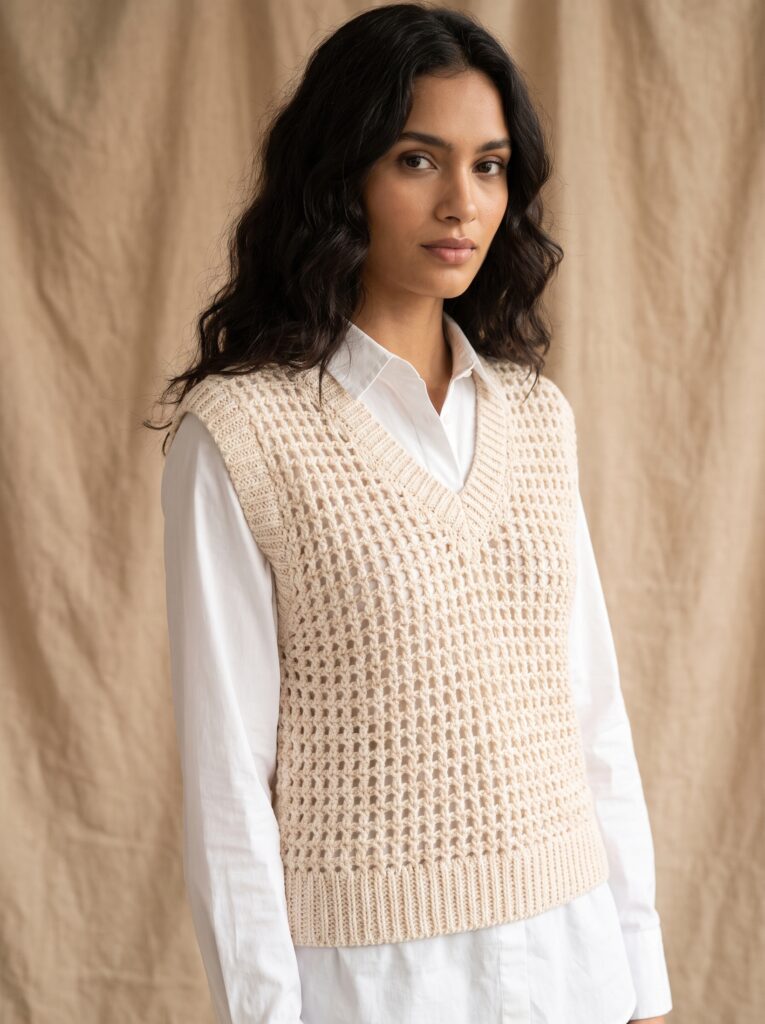
Not every fall project needs sleeves. A vest uses roughly half the yarn, takes half the time, and layers over shirts you already own.
This one is worked in a lacy grid stitch, small clusters separated by open squares, with a deep V neckline finished in ribbing. The armholes get the same ribbed treatment, and the hem band is wide enough to give the vest some structure. Length is important here: it stops right at the hip, above where the shirt tails start, which is what keeps the proportion from going frumpy.
Cream over white is the styling choice I’d copy immediately. Two neutrals, slightly different tones, layered so the collar and cuffs of the shirt show. It works with jeans and it works with trousers. For a lace fabric like this, a smooth cotton or cotton blend keeps the holes crisp instead of fuzzy. Stitch markers earn their keep when you’re tracking a repeating lace grid.
10. Terracotta, Mustard, and Cream Stripes on Linen
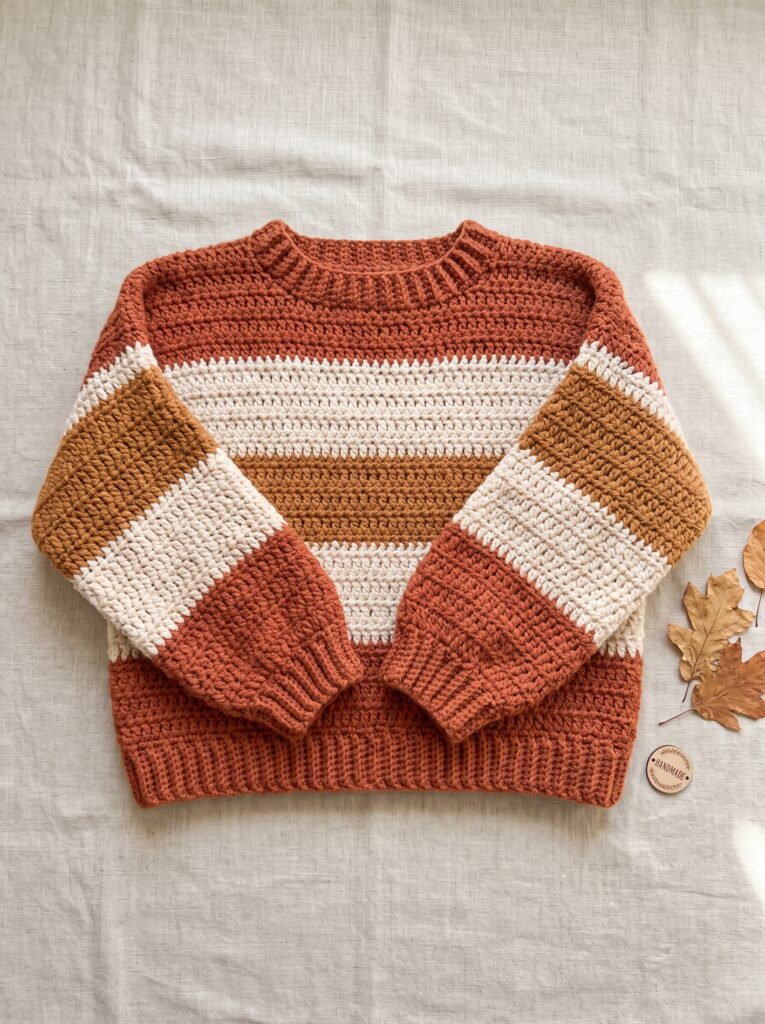
Three colors. That’s it. Terracotta, warm mustard, and undyed cream, arranged in wide bands rather than skinny stripes.
The layout is what makes it: terracotta at the yoke and shoulders, then a wide cream band, then mustard through the middle, then back to cream and terracotta at the hem. Sleeves repeat the same sequence but in a different order, so they don’t line up with the body stripes. That mismatch looks intentional and expensive.
The stitch is straight double crochet throughout, worked in rows, with ribbed edges at the collar, cuffs, and hem in solid terracotta. There’s a little leather tag stitched into the hem, which is a five-minute addition that makes a handmade sweater feel finished. Wide stripes also mean fewer color changes, so this is a friendlier project than it looks for anyone new to working with multiple balls.
11. Olive Yoke Sweater With a Shell Stitch Collar
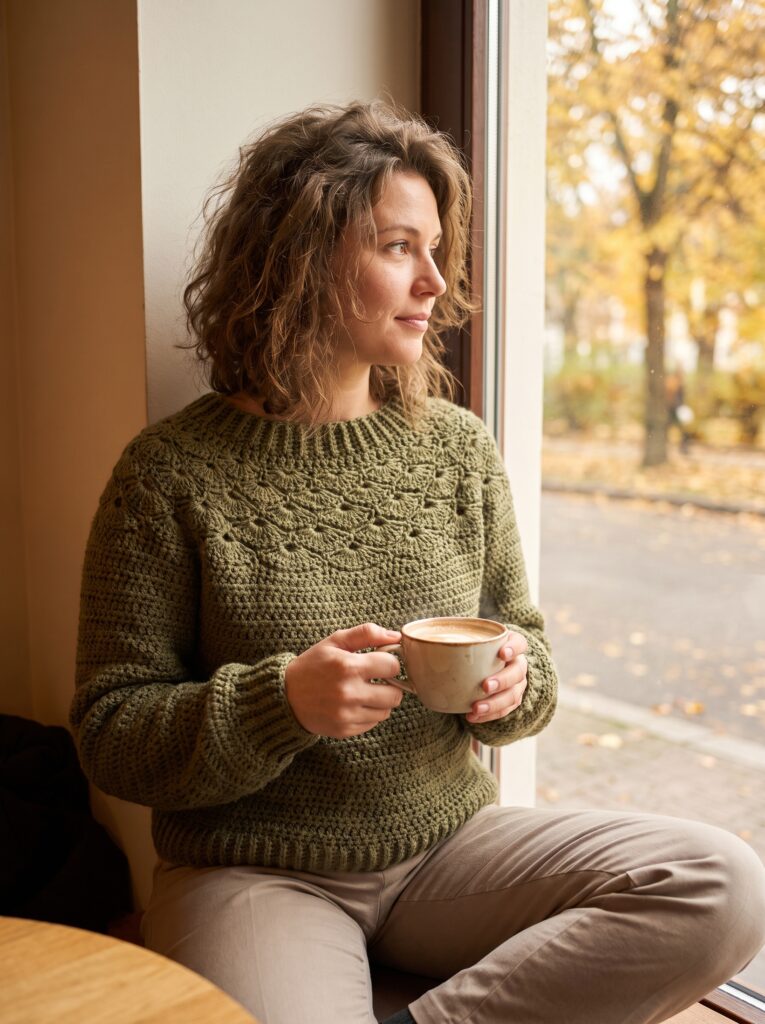
Yoke sweaters are the most flattering shape on this list. The decoration sits in a circle around the shoulders, drawing the eye up, and the body below stays plain.
Here the yoke uses a fan or shell stitch arranged in two tiers, with small picot bumps between the fans. Under that, the body drops into plain half double crochet worked in the round, so there are no side seams at all. The collar is a short ribbed band that sits close to the neck without choking. Sleeves taper down to snug ribbed cuffs.
Olive green is underrated for fall. It’s softer than forest, warmer than sage, and it goes with the tan and cream bottoms most of us already wear. Because a yoke is worked in the round from the top down, you can try the sweater on as you go and stop when the length is right. That alone makes it worth attempting even if the stitch pattern looks intimidating on the page.
12. Burgundy Cable Cardigan With Wooden Buttons and Patch Pockets
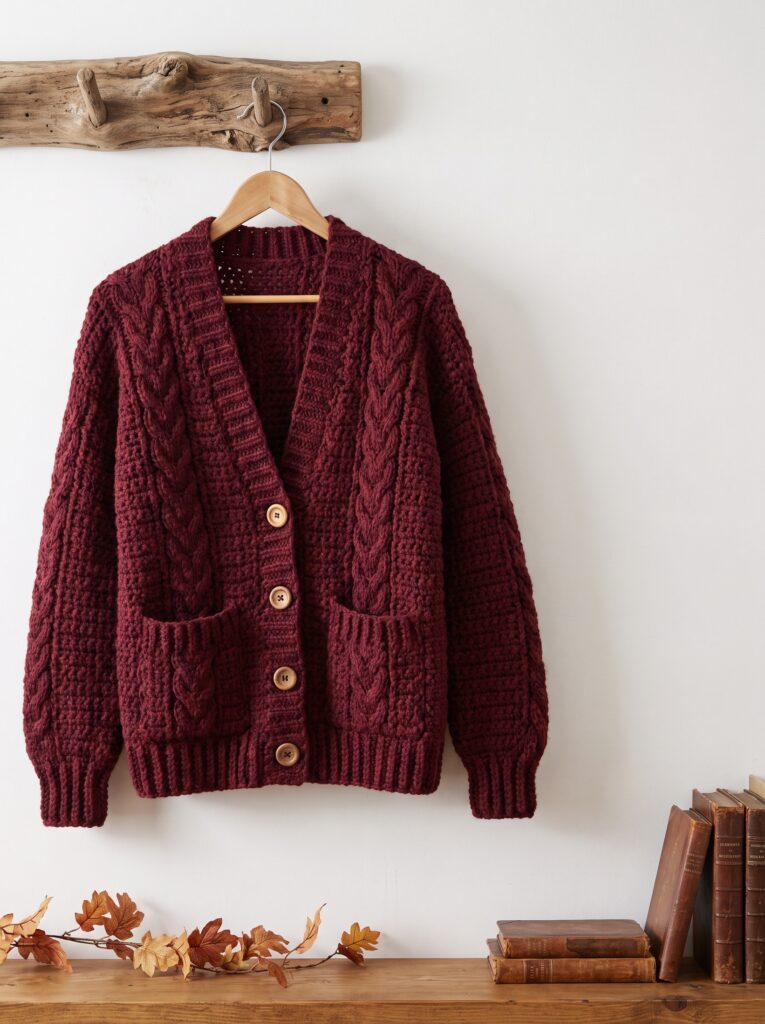
If I could only make one thing from this list, it would be this. Deep burgundy, thick cables running up both fronts and down the sleeves, four wooden buttons, and two patch pockets stitched onto the front.
The cardigan hangs with real weight on the hanger, which tells you the yarn is heavy and the stitch is dense. Between the cable columns sit panels of textured basketweave stitch. The V neckline is bordered in ribbing that continues down both front bands, and the buttonholes are worked into that band rather than added later. Pockets get their own ribbed top edge and a small cable running through the center so they match the body.
Wooden buttons are the finishing touch and they cost almost nothing.
Shop it on Amazon: Wooden Buttons for Sewing and Crafts.
Burgundy also hides the slight unevenness that shows up in early cable attempts, so it’s a forgiving color to learn on.
13. Camel Ribbed Raglan in a Sunlit Living Room
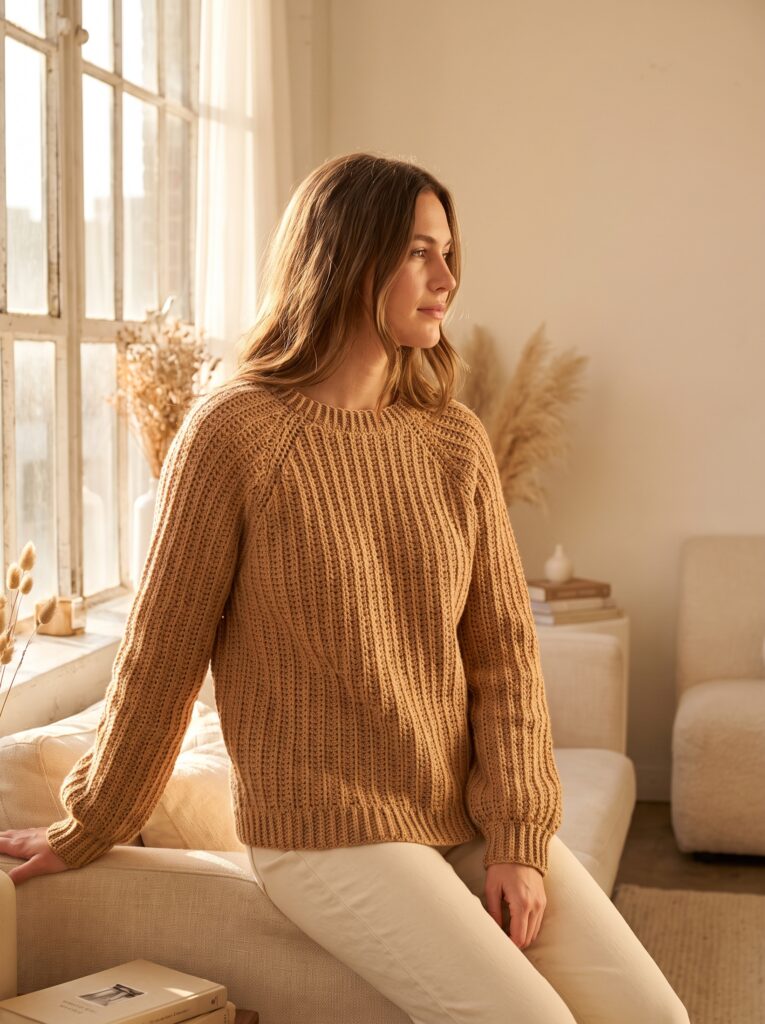
Vertical ribbing does something horizontal stitches can’t. It lengthens the torso and it makes a chunky sweater read as sleek instead of bulky.
This camel pullover is worked entirely in a fisherman rib, columns running top to bottom across the body and down the sleeves. The raglan lines are visible as smooth diagonal seams from the neck to the underarm, and the collar is a simple rolled band. Sleeves are full through the upper arm and narrow into cuffs. The hem band is ribbed horizontally, which creates a nice directional contrast against the vertical body.
Camel with cream trousers is a combination I steal every autumn. It’s tonal without being boring. To get ribbing this even, tension matters more than usual, so make a decent-sized swatch before you commit. Measuring as you go keeps the raglan from ending up too deep.
14. Granny Square Sweater in Mustard, Cream, and Forest Green
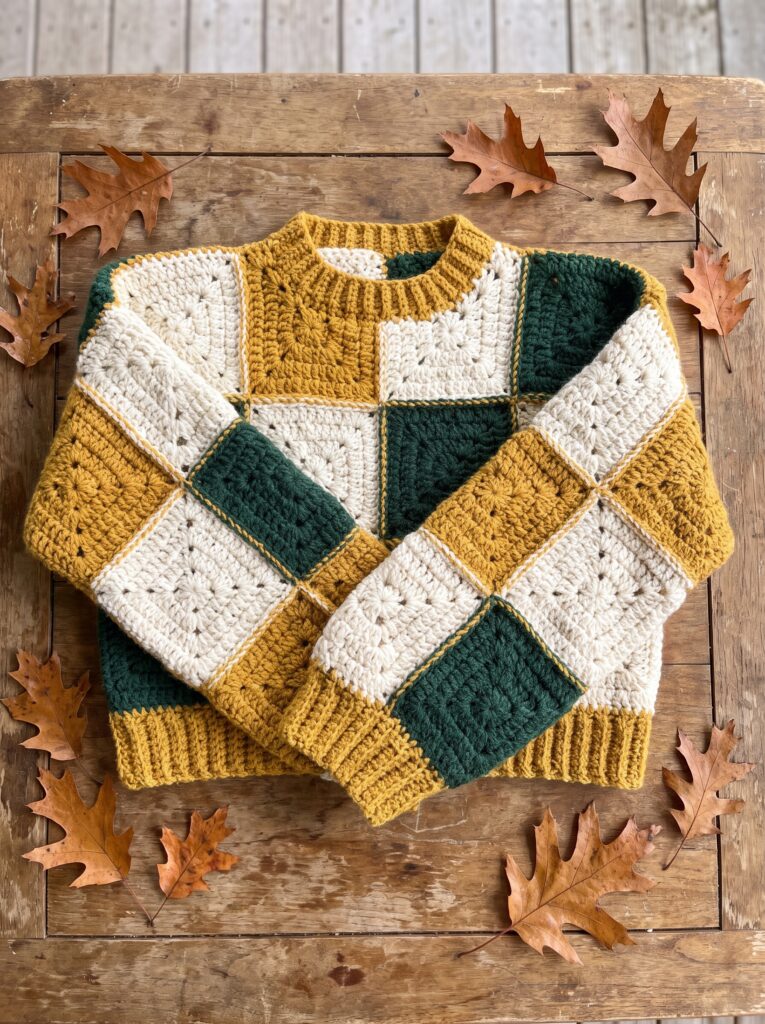
The granny square sweater refuses to go out of style, and this color combination is why. Mustard, cream, and dark forest green, arranged so no two squares of the same color touch.
Each square is a classic granny with the traditional open center, joined with a contrasting mustard slip stitch that outlines every block. The layout is a simple grid: squares across the front, squares across the back, squares down each sleeve. Neckline, cuffs, and hem all get solid mustard ribbing, which pulls the patchwork together into something that reads as one garment instead of a blanket with sleeves.
This is the most portable project on the list. Squares fit in a bag and you can make them on a train, at a game, or in front of the TV. The assembly is the tedious part, so join as you go rather than saving all the seaming for the end. A dedicated project bag keeps finished squares from wandering.
Shop it on Amazon: Yarn Storage Tote Bag for Crochet.
15. Teal Textured Pullover Styled With Dark Denim and Boots
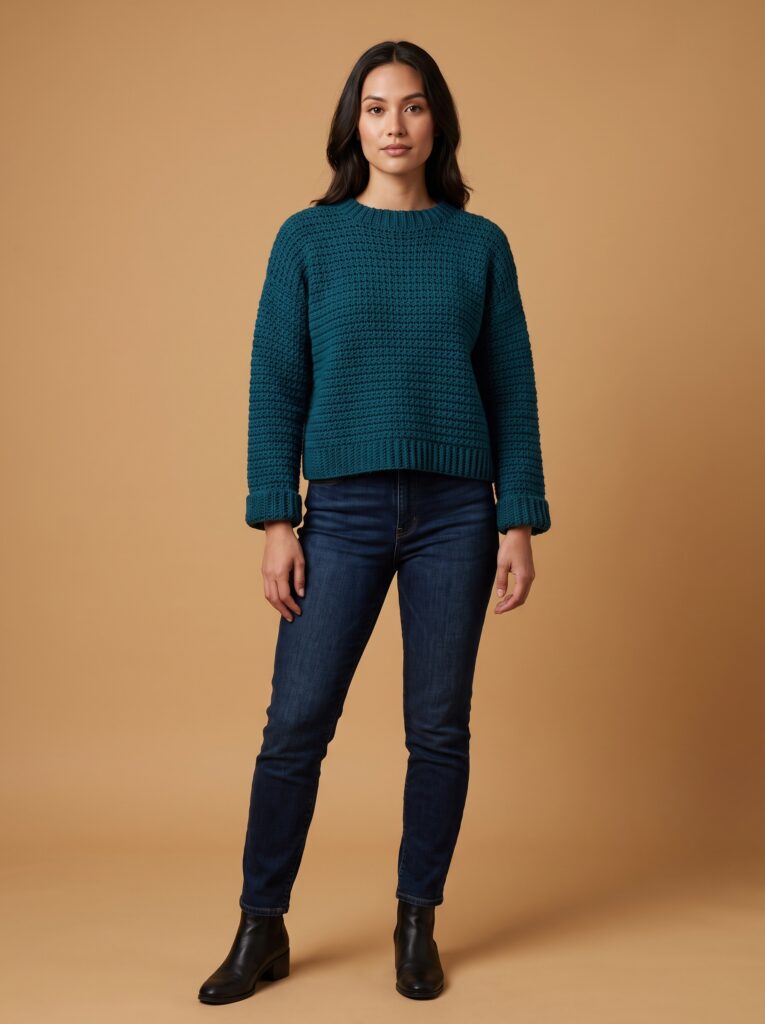
Finishing on a color that isn’t a neutral, because fall wardrobes need one. This deep teal sits between blue and green and it looks especially good with indigo denim.
The stitch is a small, tight bobble or moss texture repeated across the entire body and sleeves, giving the surface a woven, almost tweedy look from a distance. The neckline is a narrow ribbed crew. Sleeves are dropped at the shoulder and slightly voluminous, cinched into ribbed cuffs that are folded once. Length hits right at the hip, which is exactly where a sweater should end if you plan to wear it with high-waisted jeans.
Styled here with dark skinny denim and black ankle boots, it’s a genuinely wearable outfit rather than a photoshoot fantasy. That’s the mark of a pattern worth your time. If you want the same tweedy effect, look for a heathered or tonal yarn rather than a flat solid. The variation in the fiber does half the work for you.
How to Choose Yarn for a Crochet Sweater That Doesn’t Sag
The single biggest mistake in sweater making is the wrong fiber. Pure acrylic in a heavy gauge will grow. Every time. It stretches under its own weight and never bounces back.
Wool has memory, which means it springs back to shape after washing. A wool blend, somewhere around 20 to 50 percent wool, gives you memory plus easier care and a lower price. Cotton drapes beautifully but it’s also heavy and it doesn’t recover, so save it for lighter, cropped pieces like the vest and the mesh pullover above.
Weight matters too. Worsted takes longer but produces a sweater you can wear indoors. Bulky finishes fast and looks great, but you’ll overheat in anything but cold weather. If it’s your first crochet sweater, worsted is the sensible middle ground.
Always swatch. I know nobody wants to hear it. Make a six inch square in your chosen stitch, wash it the way you’d wash the finished sweater, let it dry, then measure. Ten minutes of swatching saves forty hours of regret.
Fit Tips Most Free Patterns Skip
Positive ease is what makes a sweater look intentional. Measure your bust, then add four to six inches for a relaxed fit, or eight to ten for the oversized look in several of these photos. Making a sweater to your exact measurements produces something that looks too small even when it technically fits.
Sleeve length should be measured from the underarm, not the shoulder, because shoulder drop varies wildly between constructions. Try the sleeve on before you close the cuff.
For hem and cuff ribbing, drop down a hook size. Ribbing worked at the same gauge as the body has no grip and the sweater will flare. And block everything. A finished piece that looks slightly uneven will almost always even out after a soak and a flat dry.
Pick One and Start This Weekend
Fifteen sweaters, and honestly you could work through all of them in a season if you picked the simpler shapes. Start with the openwork flat lay or the granny square if you’ve never made a garment. Move to the yoke or the ribbed raglan once you trust your tension. Save the cables for when you want a project that keeps your hands busy through November.
The best crochet sweater is the one you finish and then wear until it’s soft at the elbows. Pick the color you actually reach for in your closet, buy one more skein than the pattern says, and cast on.
Loved these ideas? Save this pin to your fall crochet board so you can find the patterns when you’re ready to start, and follow along for more free crochet sweater roundups every season.